The Library
Everything Akhrots does —
and how it works.
The Library is the open record of Akhrots: every feature you can use today, and the research beneath it — the .aal format that carries your context between models, the benchmarks we hold ourselves to, and the writing and demos behind it all.
The Features
What you can actually do in Akhrots today — capture knowledge, browse it, explore how it connects, and turn it into something new.
Memory that captures itself.
Add knowledge four ways, or let NUT capture it automatically from your AI chats and connected tools. Nothing important slips away.
- Write a note. Jot a thought with a title, value and memory type.
- Save a link. Paste any URL — Akhrots normalises and stores it as memory.
- Upload files. Drag in PDFs, images, docs or markdown and Akhrots extracts the memory.
- Connect knowledge bases. Sync Drive, Notion and OneDrive (Pro).
- Auto-capture. NUT quietly records memories from ChatGPT, Claude, Gemini & Grok.
A second brain you can browse.
Your home screen turns raw memory into a living overview — see what's captured, synced, indexed and recallable at a glance, then dive into a structured table or a Gantt timeline of everything you know.
See how everything connects.
Explore your knowledge as an interactive, force-directed graph — or as a relational network with semantic ribbons that name why two memories are linked.
- Force-directed canvas. Nodes sized by importance, colour-coded by type, clustered by source.
- Relational ribbons. Sankey-style flows labelled “Attribution”, “Inferred preference”, “Lived context” and more.
- Multi-hop exploration. Walk from one idea to the next across relationships.
- Graph Diff. Ask “what changed this week?” and watch your knowledge evolve.
- Dual view. Flip between graph and a sortable, filterable table instantly.
Turn knowledge into new knowledge.
An infinite, type-safe canvas where memory, files, skills, tools, prompts and any LLM wire together into multi-agent AI workflows. Drop a model in, connect what it should know, and run.
13+ models, ready to wire
12 built-in skills
6 tools & type-safe wiring
Conflict detection & resolution.
Most tools store contradictions silently. Akhrots notices. When two memories disagree, it raises a conflict and lets you resolve it in one click — with the source and confidence of each shown so you always know which to trust.
This is what we mean by a second brain that thinks, not just stores.
Explore Conflict ResolutionFind anything. Miss nothing.
A Cmd + K spotlight searches every memory by meaning, while a notifications centre keeps you on top of conflicts, syncs and AI suggestions.
- ⌘K spotlight. Semantic search across memories, chats, files and projects.
- Live results. Entity, type, source and confidence shown inline.
- Notification centre. Conflict alerts, integration syncs and proactive AI nudges.
- Mark-all-read & dismiss. Stay in control of the signal.
A companion, not a chatbot.
NUT is a living 3D character who remembers you, reacts to what happens in your memory, and talks back — by text or voice. It celebrates a saved memory, nudges you about a conflict, and has a personality all its own.
Under the Hood
The formats, benchmarks and engine that let your memory survive the model — the open record of how it all works.
.aal — the All‑AI Language
A portable context format. .aal stores your memory and context as a single model-agnostic file, so meaning transfers losslessly between any AI — the substrate beneath Context Fidelity™.
- Model-agnostic. Written once, read by GPT, Claude, Gemini, Grok or local models.
- Complete. Carries memories, entities, relationships and context packs in one file.
- Durable. Survives model swaps, session restarts and agent handoffs.
- Diff-friendly. Human-readable — version your knowledge like code.
@aal      1.0
@origin   claude-opus-4
@fidelity 0.98
@portable true

memory "cafe-startup-idea" {
  type:     idea
  created:  2026-03-14
  entities: [#cafe, #startup, #ai-infra]
  summary:  "A café that doubles as an AI workspace."
  links:    ~funding, ~market-research
}

context.pack {
  recall:  semantic("startup ideas about cafés")
  include: [decisions, notes, files]
  budget:  8k
}
Sample shown for illustration — the published .aal specification will live in this section.
Know moreContext Fidelity™
Our benchmark for how much meaning survives a model handoff. We measure what's preserved when context moves Claude → GPT → Gemini, so nothing important is lost in translation.
Figures are illustrative targets — live benchmark results will be published here.
Know moreMulti-LLM Orchestration
Powered by GML. One memory layer that every model reads from and writes to — with routing that picks the right model for each task.
NUT OS
An experiment in making memory tangible: NUT as a living 3D desk companion that physically stores what you save — memories as crystals, walnuts and glowing orbs, and each project as a tiny world.
Connect & Control
Plug Akhrots into the tools you already use — and keep your memory private, portable and entirely on your own terms.
Connected to where you already work.
Pull memory from your whole stack — and connect any MCP-compatible agent or tool through an open standard.
Your memory. Your rules.
Akhrots is privacy-first: you decide what's captured, how long it's kept, and you can take it all with you — or delete it — at any time.
- Auto-capture toggle. Turn passive memory capture on or off.
- Per-source redaction. Sensitive content is stripped before it's stored.
- Retention control. Keep memories forever, 1 year, 90 days or 30 days.
- Export & delete. One-click data export and a full delete-all control.
- Enterprise. Self-hosting, audit logs, SOC 2 and bring-your-own vector DB on Akhrots Cloud.
Why Akhrots
How it stacks up against everything else, and straight answers to the questions people ask most.
Everyone else does one thing.
ChatGPT talks. Notion stores. Obsidian links. Mem remembers. LangGraph orchestrates. Akhrots unifies all of it into one system that thinks.
| Capability | Akhrots | ChatGPT | Notion | Obsidian | Mem | LangGraph |
|---|---|---|---|---|---|---|
| Durable memory across models | ✓ | — | — | — | ~ | — |
| Portable context format (.aal) | ✓ | — | — | — | — | — |
| Knowledge graph | ✓ | — | ~ | ✓ | — | — |
| Conflict detection & resolution | ✓ | — | — | — | — | — |
| Multi-agent AI workflows | ✓ | ~ | — | — | — | ✓ |
| Multi-LLM orchestration | ✓ | — | — | — | — | ✓ |
| AI companion (NUT) | ✓ | — | — | — | — | — |
✓ built-in · ~ partial · — not offered. Comparison reflects Akhrots' positioning as of 2026.
Questions, answered.
What can Akhrots actually do?
Akhrots captures memory from your AI chats, files and tools; organises it in a browsable Brain dashboard and a living memory Graph; lets you build multi-agent AI workflows on the Nodes canvas; detects and resolves conflicting memories; searches everything with Cmd + K; and gives you NUT, a 3D AI companion. It works across ChatGPT, Claude, Gemini and Grok with multi-LLM orchestration and a portable .aal context format.
How does Akhrots handle conflicting memories?
Akhrots automatically detects when two memories disagree — for example “Lives in Pune” versus “Lives in Mumbai” — and surfaces a conflict notification. You resolve it in one click: keep the first, keep the second, or keep both, with confidence and source shown for each so you can decide which to trust.
Which AI models can I use inside Akhrots Nodes?
The Nodes workflow canvas supports 13+ models including Claude Opus 4.8, Sonnet 4.6, Haiku 4.5 and Fable 5; GPT-5, GPT-5 mini and o4; Gemini 2.5 Pro and Flash; plus Grok 4, Llama 4 Maverick, Mistral Large and DeepSeek V3. You wire them together with type-safe sockets alongside skills, tools and your own memory.
Can I control my privacy and export my data?
Yes. Akhrots gives you auto-capture toggles, per-source redaction, a retention setting (forever, 1 year, 90 days or 30 days), one-click data export and a delete-all control, so your memory layer stays under your ownership.
From the Library
Essays, build logs and product thinking from the team on nature-inspired intelligence.
From the blog
Intelligence was never artificial
Why we believe nature solved intelligence first — and what that means for the systems we build.
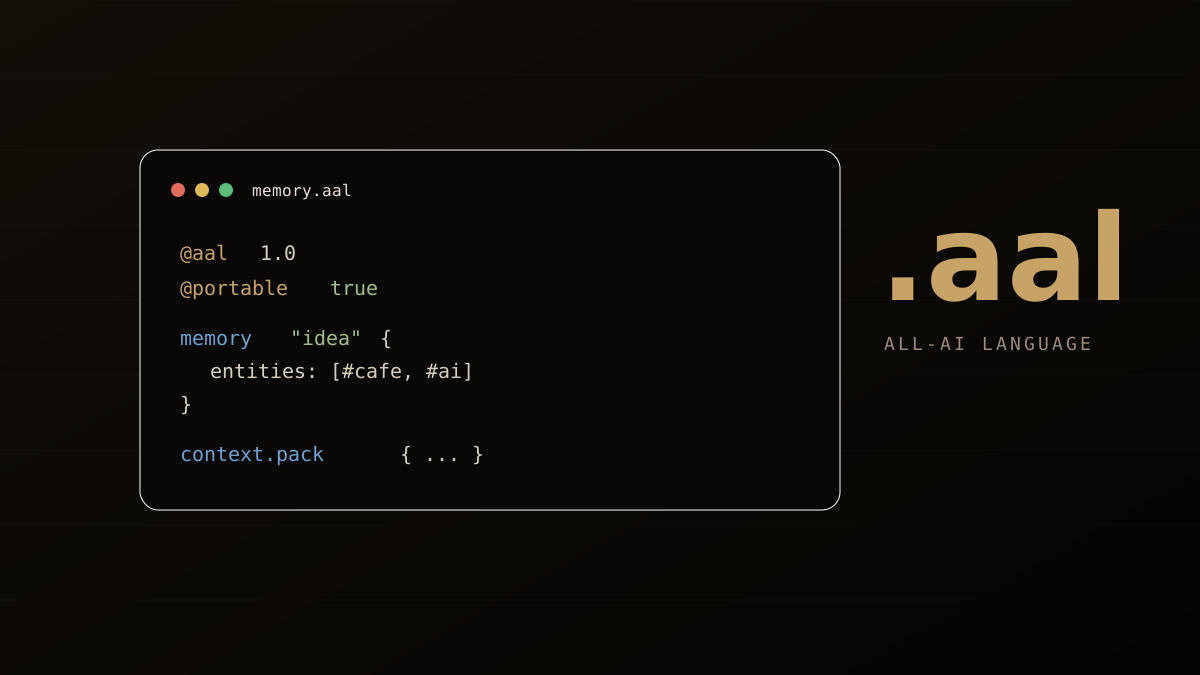
Introducing .aal — the All-AI Language
A portable context format that lets your memory move losslessly between any model.
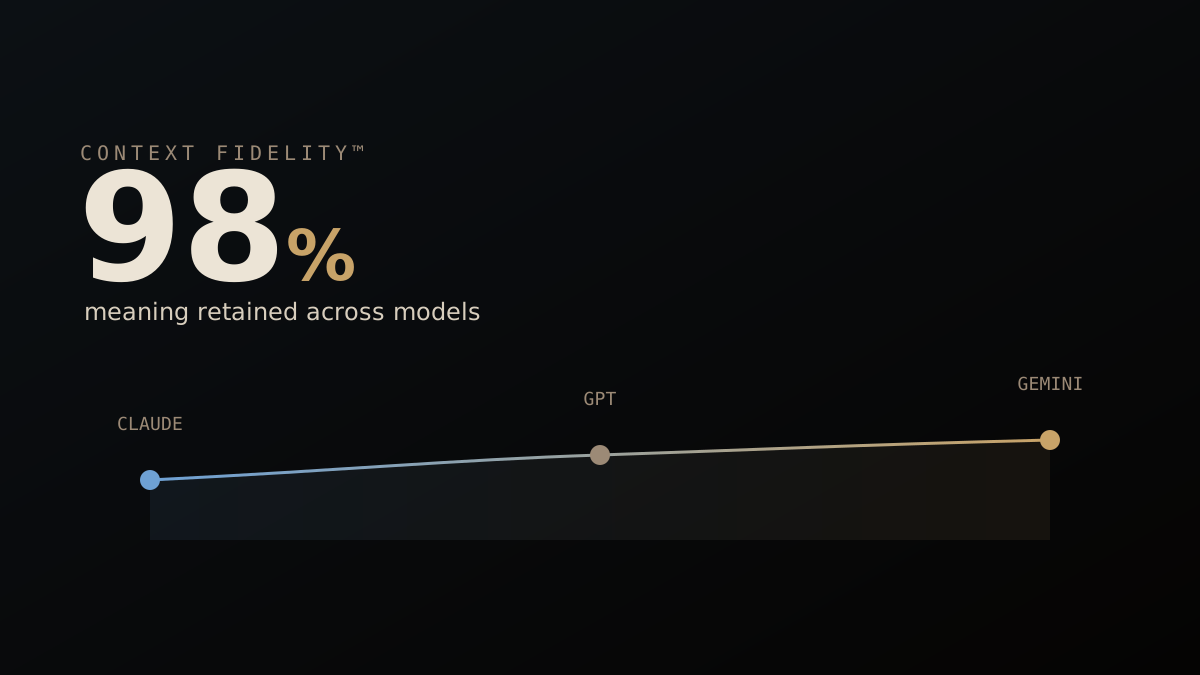
Measuring Context Fidelity™
How we think about the meaning that survives when context crosses from one model to another.
What’s Next
On the workbench — research, demos and writing still in progress. Here’s what’s coming.
The archive
- Research Natural systems, adaptive interfaces & cognition
- Blogs Essays, build logs & product thinking from the team
- Demos Product walkthroughs & demonstration videos